
Best Mulch for Perth Gardens
We all know we must mulch of gardens. But when we get to the soil yard, we are confronted by a plethora of different looking mulches. Which one is the best? Which one do I actually need? Are colors more important than textures? What about what they’re made from?? What do they do???
Well short answer is not so short but not too long either. Wood chips are generally for trees and straws/hays are usually for vegetables. There are also crushed stone options. All other options Suburban Farmer does not recommend. Painted and dyed mulches I do not recommend either.
Cost or composition? Most will go for cost as it can get expensive. But just like anything that we are constantly using (mulches are biodegradable so have a usage time allowance) we want to make sure we get value for money. But what is value? Cheap mulch that covers a lot of quality correct mulch that covers less?
Choosing cost over composition can lead you to having to buy more, apply more often and worst-case scenario, have to redo the lot again with correct mulch. Incorrect mulches can cause issues with your soils health. Black Budget Mulches are common as they are cheap. They are also black and in our Perth Summers, the roots that the mulch is covering heats up and burns. Many cheap mulches also have poor particle size and can become close knitted like a platelet and dry like a biscuit becoming hydrophobic and repelling water. Made from poor and small prunings these mulches do not last very long and provide little nutrition.
Expensive mulches and dyed mulches/decorative mulches should never be used in an edible garden setting. Footpaths and throughfares that are not in contact with edible plants and groundcovers are appropriate. The dyes and additives are hazardous to plant and soil life, and thus, if we are eating from the same soil, we will be affected also. They will also leach and run down the road, fade and break down very quickly.
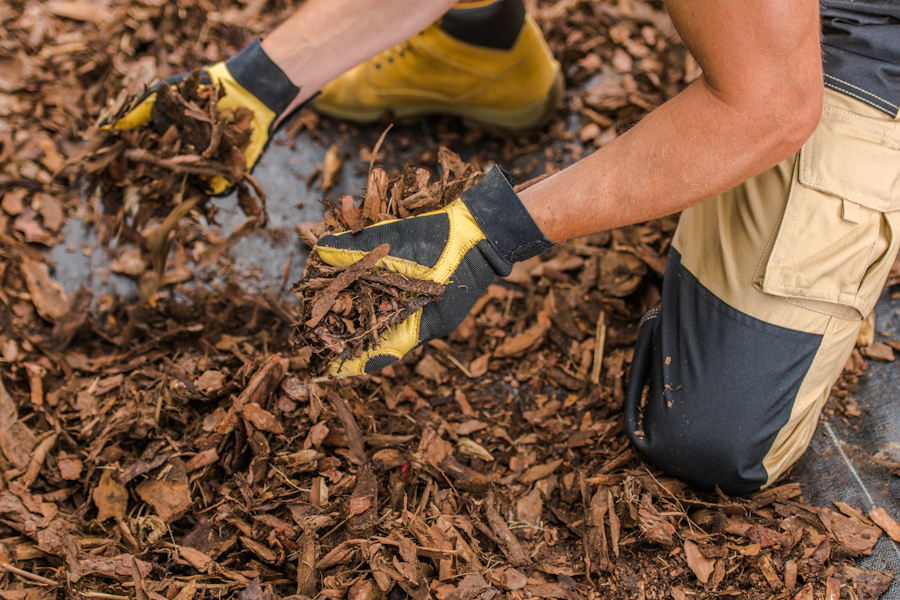
Hardwood mulches are perfect for food forests agriculture. Especially locally sourced woodchips. They come in two main types. Single size or mixed/rough. Single is ok but degrades quickly. It looks pleasing to the eye over rough sized wood chip mulch however the latter is better at longevity and creating the right conditions for fungal life. Great for water holding and directing, soil conditioning and soil life health.
Straw/hay mulches are great for vegetable gardens as they provide nitrogenic nutrition and soil conditioning, temperature balancing and also a lovely place for chewing insects to cuddle up and breed.
Both are great and can actually be interchanged and used. I line my footpaths every season with a layer of hardwood rough chopped wood chip mulch, them every Winter I layer straw/hay mulch over the paths to create more conditions for bacterial and fungal colonization. My garden beds are mulched with LIVING MULCH GREEN MANURES AND COVER CROPS.
If you see a local arborist, stop and ask what their jobs are today, and if it’s native hardwood or regular tree pruning’s? If it’s not native, clean hardwood politely decline and look elsewhere. It costs them money to dump their loads, and many are more than happy to delivery and dump in your front yard. Be wary that load sizes can exceed 10 cubic meters so sufficient space, time and overhead clearance is needed.
Be aware of spreading pathogens, viruses and invasive insects like PSHB.
Once a load is secured and delivered, get 4-8 90-100mm pvc pipes about 1-1.5m tall, drill with a hole saw some 20mm holes around each pipe but avoid too many holes as not to weaken the pipes. Try and pierce the pvc pipes into the guts of the pile like skewers. This will allow for more air flow and temperature control. Grab a hose and throw the sprinkler on the top of the pile and once a week, water it for 10 minutes. Mill down and mix with water some seaweed pellets or powder, some fish emulsion or pellets and some rock dust then apply to the mulch pile. Do this once and then again in two months, at six months and again at the one-year mark. Most large biomass mulch piles should sit and settle/activate over a period of 1-2 years. More for larger piles. The mulch will shrink in volume by over half. The mulch will go from good wood at the top to dark brown, full and partly broken down, humic rich mulch. Apply along foot paths and establishing areas, fallow areas and siding up beds, rows and guilds.
Blissful Love Ras Mark Suburban Farmer